
Dave Bondy
Politics • Culture • News
The mainstream media has neglected its duty in reporting the University of Georgia student murder properly
Media fails to focus on suspect's illegal immigration status
February 26, 2024
post photo preview

The media has not adequately addressed the tragic case involving the murder of a college student in Georgia, allegedly committed by an individual who entered the country illegally. This lack of comprehensive coverage highlights a significant oversight in reporting on issues of critical public concern.

Since the beginning of Joe Biden's term as president, the United States has seen an influx of approximately 7.3 million undocumented immigrants, raising significant concerns about border security and its implications for national safety.

I've gone from a high-paying mainstream media job to independent journalism. I am exposing media bias, and sharing untold stories. Support my mission by subscribing for just $5 a month; you can cancel anytime. Join me in challenging the prevailing narratives. Click the become a supporter button below to join.

This issue is increasingly becoming a focal point as the 2024 Presidential Election approaches, even surpassing concerns about the economy and the country's involvement in conflicts overseas.

The Biden administration's dismissal of these concerns as extremist views contrasts sharply with the tangible impact on the daily lives of many Americans.

Among the underreported consequences of this immigration policy is the tragic case of Laken Riley, a 22-year-old nursing student from Georgia, whose death has largely been ignored by major media outlets.

This lack of attention is attributed to the perpetrator being an undocumented immigrant, a narrative that doesn't align with the current administration's stance on immigration.

Laken Riley, studying nursing at Augusta University, was found deceased after she went missing during a jog, a victim of blunt force trauma. The suspect, 26-year-old Jose Antonio Ibarra from Venezuela, was apprehended in connection with her murder. His brother, Diego, was also detained on unrelated charges that highlight issues with immigration enforcement.

Take a look at the below headline from CNN. CNN updated this story on Sunday, February 25 and failed to highlight the suspect was an illegal immigrant.

The community and the University of Georgia have expressed deep sorrow over Riley's untimely death, praising her character and academic achievements. The authorities believe Ibarra acted alone, with no evidence suggesting he had any prior connection to Riley or an extensive criminal history, despite previous legal issues related to illegal entry into the U.S.

The case underscores broader concerns about the current immigration policies and their enforcement, as Ibarra's ability to remain in the U.S. after prior arrests points to systemic issues. Georgia Governor Brian Kemp has criticized the federal administration for its border policies in light of such incidents.

Despite the gravity of Riley's murder and its potential as a high-profile case, it has not received significant media coverage, contrasting with other high-profile cases in recent years. This has led to criticisms of the media and the administration for their handling of immigration issues and the perceived downplaying of crimes involving undocumented immigrants.

Instead of focusing on the issue of illegal immigration and how it was directly impacted on this case, the Associated Press published a story about how jogging can be dangerous for women. No mention of the suspect’s illegal immigration.

Border Patrol's arrest statistics reveal a concerning number of criminal non-citizens, including those with violent crime convictions, yet these figures and cases like Riley's murder receive limited attention, highlighting a disconnect between media coverage and the reality of immigration-related challenges.

Newsweek published a story with the headline, “MAGA demands death penalty for migrant arrested over killing of Laken Riley.”

I believe that regardless of political leanings, a significant number of Americans might support the imposition of the death penalty in this particular case.

Monday morning I went onto nbcnews.com and could not find this story on their home page. This is a perfect example of the mainstream media attempting to set a narrative. The narrative of this story is to avoid it altogether.

I do give credit to FOX5 in Atlanta, Georgia for covering the story properly.

The television station published and aired numerous stories that went into detail about the background of the suspect.

This is not an isolated case. Illegal immigrants have been committing crimes against Americans in growing numbers.

Oakland County, Michigan Sheriff Michael Bouchard called in September of 2023 for tighter border security as his office works with multiple agencies to intercept the efforts of "transnational gangs" involved in "high-end burglaries," prowling across Oakland county and throughout the nation.


At a press conference, the sheriff outlined the ongoing investigation into a series of burglaries that have significantly impacted Michigan's second-largest county, causing extensive financial loss estimated in the "hundreds and hundreds of thousands of dollars." While the sheriff did not provide specifics on arrests or other investigative details, he mentioned that officials have identified certain patterns or "specific threads" related to the incidents.
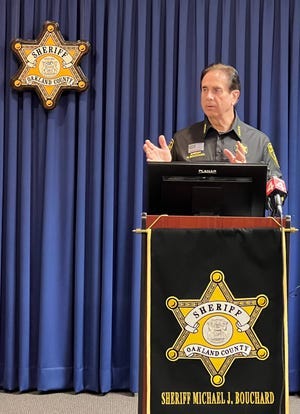
Oakland County Sheriff Michael Bouchard details what authorities have learned about "transnational gangs" involved in "high-end burglaries" across the county on Friday, Sept. 29, 2023.

"These are transnational gangs that are involved in this that come from South America, looking to do burglaries and violate our communities, not just in Oakland County but across America," Bouchard said. "It's criminality at its organized crime best in terms of that's how it functions. They work together, and they're here for a specific purpose."


Tammy Nobles, the mother of 20-year-old Kayla Hamilton who was autistic and tragically raped and murdered in 2022, has filed a $100 million lawsuit against the U.S. federal government.

She alleges that the Department of Homeland Security and the Department of Health and Human Services failed to prevent an MS-13 gang member from El Salvador, who is accused of her daughter's murder, from entering the U.S. due to insufficient background checks.

Nobles testified before a House panel, emphasizing that her concern is about safety, not politics, and expressed her determination to bring awareness to border security issues.

The lawsuit claims that the suspect, a 17-year-old from El Salvador, was known to be a gang member and could have been easily identified and barred from entry with proper vetting. The suspect, who was living with Hamilton, was arrested after DNA evidence linked him to the crime. Nobles and her attorney argue that this case highlights a broader failure by federal agencies to protect U.S. citizens.

The Department of Homeland Security and the Department of Health and Human Services have expressed sympathy but have not commented on the ongoing litigation. The case has also sparked criticism from some members of Congress regarding the current administration's border policies.


The mainstream media often crafts narratives that seem politically driven, which in my view, overlooks the nuanced and real-world consequences of illegal immigration. This oversight underscores the vital role of independent journalists who operate free from corporate influence, ensuring a diversity of perspectives and stories are shared with the public.


community logo
Join the Dave Bondy Community
To read more articles like this, sign up and join my community today
0
What else you may like…
Videos
Posts
Articles
September 16, 2026
Gas prices are climbing fast in Michigan, with some stations reaching nearly $5 a gallon. Here’s what’s driving the increase and what could happen next. Michigan GasPrices Economy

Gas prices are climbing fast in Michigan, with some stations reaching nearly $5 a gallon. Here’s what’s driving the increase and what could happen next.

#Michigan #GasPrices #Economy

00:01:17
September 12, 2026
Michigan schools have lost more than 100,000 students in just nine years, but somehow, they’ve added more than 35,000 full-time employees.

Michigan schools have lost more than 100,000 students in just nine years, but somehow, they’ve added more than 35,000 full-time employees.

00:01:21
September 09, 2026
E-bike crashes involving kids are getting attention in Michigan — and now a state lawmaker wants tougher rules. Would new age restrictions go too far? Michigan EBikes news

E-bike crashes involving kids are getting attention in Michigan — and now a state lawmaker wants tougher rules. Would new age restrictions go too far? #Michigan #EBikes #news

00:01:04
September 20, 2026
A doctor breaks the silence about his truth about hospitals

A doctor breaks the silence about his truth about hospitals.

September 20, 2026

Dave all of your followers can get here through Rumble just let them know to press the red"join" button

September 13, 2026
post photo preview
Bay City Built EV Chargers and Now It’s Pulling the Plug
We dig deep into the issue

In 2009, Bay City looked at the electric car and saw enough of a future to start preparing for it.

This was before the Tesla Model S. Before Ford sold an electric F-150. Before seemingly every automaker had an EV somewhere in its lineup, and long before charging stations started appearing outside grocery stores, dealerships and highway exits.

Bay City Electric Light & Power installed two electric vehicle charging stations downtown. They were free for drivers to use, and the municipal utility was already talking about installing more.

Seventeen years later, the electric cars arrived and the chargers just couldn’t keep up.

On October 1, Bay City plans to disconnect its two remaining city-funded public charging stations, located near the Jennison building and Delta College Planetarium. City officials discussed the decision during the August 17 City Commission meeting, citing both the outdated technology and the continuing burden on Bay City Electric ratepayers.

The chargers are Level 1.

For a modern electric vehicle, a full charge using one can take as long as 50 hours.

No, that’s not a typo. A driver could plug in Monday morning and potentially still be waiting Wednesday morning.

It is an almost perfect little story about the problem with being early to technology. Bay City installed public electric vehicle charging infrastructure at a time when most Americans probably couldn’t name a production electric car. The city kept the electricity free. The chargers survived for the better part of two decades.

Then the technology they were built to support improved so dramatically that the chargers themselves became increasingly difficult to justify.

Share

The decision to disconnect them does not mean Bay City is banning electric vehicles, abandoning electrical transportation or preventing businesses from installing chargers. In fact, the city’s proposed zoning language in 2026 goes in almost exactly the opposite direction. Bay City has been considering regulations intended to facilitate EV charging infrastructure, including requirements that certain new multifamily developments install conduit so chargers can be added later.

Bay City Electric Light & Power later described those first two chargers as free public stations installed by the utility. Five years later, the utility expanded its involvement in EV infrastructure by partnering with the Michigan Department of Natural Resources and Adopt a Charger on a station at the Bay City State Recreation Area.

That charger opened in October 2014 and was billed as the first electric vehicle charging station installed at a Michigan state park.

At the time, Bay City Electric was proud of being early. Utility staff said they hoped to install additional chargers around the city and promote electric vehicles in the process.

In 2014, building a public charger at a state park was notable enough for a grand opening. In 2026, PlugShare, one of the country’s major EV charging directories, lists dozens of public charging locations in and around Bay City, including 13 DC fast chargers. Private businesses, dealerships and national charging networks have filled a market that barely existed when Bay City installed its first plugs.

The city’s original chargers are now competing with infrastructure capable of doing in minutes or hours what they may need the better part of two days to accomplish.

That makes October’s shutdown less a story about Bay City rejecting electric cars than a question about what a city is supposed to do when technology it purchased becomes obsolete.

During discussion of the chargers, city officials considered their cost, usage and the possibility of third-party partnerships or grants for upgraded equipment. But the immediate decision was simpler: the existing city-funded chargers will be disconnected.

That leaves an important question unanswered: Were they worth it?

Seventeen years is a long time for any piece of public technology to remain in service, particularly one installed during the infancy of the industry it supports. Yet determining whether Bay City’s experiment was successful requires more than knowing when the chargers were installed and when they will be shut off.

Subscribe now

It requires knowing how they were actually used.

What did the equipment and installation originally cost?

How many vehicles have plugged into them since 2009?

How much electricity has Bay City given away over 17 years?

And how much are electric customers actually saving by disconnecting them?

Bay City has not publicly provided enough information to answer any of those questions exactly.

The original project probably cost thousands of dollars rather than tens of thousands, but even that comes with an asterisk. Level 1 charging can be as simple as allowing a driver to connect to an ordinary 120-volt outlet. If Bay City Electric used existing electrical service and its own employees, the cost may have been relatively modest. If workers had to trench through pavement, pour concrete, construct pedestals, install signs or run new circuits, the total could have climbed considerably higher.

A broad estimate of several thousand dollars for the pair is plausible.

Electricity use can be approached more mathematically.

A conventional Level 1 connection operating on a 120-volt, 15-amp circuit can continuously draw approximately 1.44 kilowatts. Some Level 1 equipment can provide closer to 1.9 kilowatts, so the specifications of Bay City’s chargers would still matter. Using the more conservative 1.44-kilowatt figure, one vehicle connected for three hours would consume no more than approximately 4.3 kilowatt-hours.

That gives us a way to construct several scenarios without pretending we know which one reflects reality.

If the two chargers collectively averaged one three-hour charging session per week, they would have hosted approximately 887 charging visits over 17 years and distributed about 3,800 kilowatt-hours.

If they averaged two sessions per week, those figures would increase to approximately 1,774 visits and 7,700 kilowatt-hours.

At one session per day between the two locations, the total would be approximately 6,200 visits and 27,000 kilowatt-hours.

At two sessions per day, it would be approximately 12,400 visits and 54,000 kilowatt-hours.

Those are charging visits, not necessarily 12,400 different vehicles. One local driver using the same charger regularly could account for dozens or hundreds of sessions. The calculations also assume that a connected vehicle drew the full 1.44 kilowatts throughout each three-hour visit. A car that was nearly full, stopped charging or drew less power would reduce the total.

Usage almost certainly was not consistent across all 17 years, either.

During the chargers’ earliest years, the number of vehicles capable of using them would have been tiny. Activity presumably increased as the Chevrolet Volt, Nissan Leaf, Tesla models and other plug-in vehicles became more common. Treating 2009 like 2025 would therefore be misleading, even if the final average happened to resemble one of these scenarios.

There is an upper limit.

If both chargers delivered 1.44 kilowatts every minute of every day for 17 years, they would have consumed approximately 429,000 kilowatt-hours. If the equipment can deliver closer to 1.9 kilowatts, that ceiling rises to approximately 566,000 kilowatt-hours.

Those figures are not estimates. They represent the physical maximum under continuous operation. Reaching them would require both charging spaces to remain occupied around the clock for 17 years without interruption.

Reality was unquestionably some fraction of that.

The dollar value depends on which kind of cost is being discussed.

If electricity is valued across the period at an illustrative range of 10 to 17 cents per kilowatt-hour, one combined three-hour session per week would place the lifetime retail value between approximately $380 and $650.

Two sessions per week would produce a lifetime value between approximately $770 and $1,300. One session per day would place it between approximately $2,700 and $4,600. Two sessions per day would put it between approximately $5,400 and $9,100. Even four combined sessions per day, every day for 17 years, would represent approximately 107,000 kilowatt-hours with a retail value between roughly $10,700 and $18,200.

Those numbers should not be mistaken for Bay City Electric’s actual expense.

A retail electric rate pays for considerably more than the immediate energy flowing through an outlet. It helps support employees, power plants, purchased electricity, poles, wires, substations, debt and the rest of the system required to deliver reliable power. Most of those expenses do not disappear when two chargers are disconnected.

The driver wasn’t paying, but that does not automatically mean other customers absorbed the full retail value of every kilowatt-hour.

The more relevant financial question is Bay City Electric’s avoided cost: how much less the utility will spend because it no longer has to produce or purchase the electricity those chargers would have consumed. That figure could vary depending on when the vehicles charged, where the utility obtained its power and whether charging occurred during periods of high system demand.

It is likely lower than the electricity’s retail value.

The same scenarios demonstrate how modest the direct annual savings could be.

At one three-hour session per week, the chargers would distribute approximately 225 kilowatt-hours annually. At a retail comparison of 17 cents per kilowatt-hour, that electricity would be worth about $38.

At two sessions per week, it would be worth about $77 annually. At one session per day, it would be worth approximately $268. At two sessions per day, it would be worth approximately $536.

Even four three-hour charging sessions every day between the two locations would represent only about $1,070 in electricity at that retail comparison. The utility’s actual avoided energy expense could be smaller.

There is a meaningful difference between shutting down two chargers because they are consuming thousands of dollars in electricity and shutting them down because aging equipment is no longer useful enough to warrant future maintenance.

Bay City Electric is not an investor-owned utility sending profits to distant shareholders. It is a municipally owned utility serving the city and portions of surrounding townships. Ultimately, the costs it absorbs remain within that publicly owned system.

That makes describing the electricity as simply “free” slightly misleading. The drivers were not paying for it but somebody was.

If the chargers were heavily used, Bay City Electric customers were subsidizing a modest amount of electricity in exchange for providing a downtown amenity. If they were barely used, the electricity itself may have cost almost nothing, but maintaining dedicated public equipment for a handful of drivers would become harder to defend.

Either possibility is more useful than arguing about electric vehicles in the abstract.

The chargers themselves also show how dramatically the meaning of EV infrastructure has changed. Level 1 charging is essentially the bottom rung of electric vehicle charging. It uses comparatively little power and works best when a vehicle can remain connected for a very long time.

For a public downtown charger, the equation is different.

Someone visiting the Delta College Planetarium is not staying for 50 hours. Neither is somebody eating dinner downtown, attending an event at Wenonah Park or spending an afternoon shopping.

Federal energy guidance estimates Level 1 charging can add only a few miles of range during each hour a vehicle remains connected. A three-hour downtown visit might therefore provide roughly enough electricity for another 15 miles of driving.

Current charging maps illustrate how much the landscape has changed. PlugShare lists 43 public charging stations in the Bay City area, including 13 DC fast chargers. Networks represented locally include Tesla Supercharger, ChargePoint, Blink and Electrify America.

The private market Bay City Electric hoped to encourage is no longer theoretical. That creates an interesting possibility: perhaps Bay City’s chargers did not fail at all.

Maybe they simply lived long enough to become unnecessary.

Municipal governments sometimes build infrastructure because the private market has not yet provided it. A city creates a parking lot, industrial park, broadband network or other public amenity because officials believe the investment can encourage activity that would otherwise struggle to develop.

Public EV charging in 2009 fit that description remarkably well.

Nissan would not begin selling the Leaf in the United States until the following year. Chevrolet’s Volt arrived around the same period. Tesla was still a tiny automaker best known for an expensive two-seat Roadster.

Bay City Electric was installing public charging stations anyway. Five years later, it helped put one at a state park and publicly talked about expanding further.

Today, an EV driver around Bay City can choose among infrastructure operated by private charging networks and businesses with equipment considerably more capable than those original municipal plugs.

If that was the outcome Bay City hoped for in 2009, unplugging two obsolete chargers in 2026 isn’t necessarily an admission of defeat.

It may simply be the end of the experiment. Still, there is a legitimate argument for asking why the city isn’t upgrading them.

Public charging in downtown Bay City serves a different purpose than a fast charger beside a highway. A visitor can park, plug in, eat at a restaurant, visit the planetarium, walk through downtown or attend an event while the car charges. The charger becomes less a fuel station than another amenity attached to the parking space.

A modern Level 2 charger could perform that job considerably better than the equipment being disconnected.

And Bay City has one obvious advantage most municipalities do not: it owns an electric utility.

Bay City’s own planning policy suggests officials still expect electric vehicles to become a larger part of transportation. Proposed zoning language states that charging stations should be placed in convenient and safe locations and kept in working order to promote electric vehicle use and confidence in the city’s charging network. The same language would allow EV spaces in commercial, institutional, office and industrial developments and require charging infrastructure in certain larger multifamily projects.

The available math suggests the direct electricity savings could amount to hundreds of dollars per year, perhaps less, depending on how frequently the stations are actually used. Maintenance and repair costs could make the decision considerably more defensible, but the city has not yet publicly separated those expenses from the cost of the electricity itself.

Until Bay City releases the original invoices, meter readings, usage records and maintenance history, nobody outside the utility can say exactly what the experiment cost or how much its ending will save.

Whether the chargers were a burden, a bargain or simply a small public experiment that ran its course depends on numbers Bay City should already have.

The rest is just estimating what came through the plug.

Read full Article
post photo preview
Bay City Built EV Chargers and Now It’s Pulling the Plug
We dig deep into the issue

In 2009, Bay City looked at the electric car and saw enough of a future to start preparing for it.

This was before the Tesla Model S. Before Ford sold an electric F-150. Before seemingly every automaker had an EV somewhere in its lineup, and long before charging stations started appearing outside grocery stores, dealerships and highway exits.

Bay City Electric Light & Power installed two electric vehicle charging stations downtown. They were free for drivers to use, and the municipal utility was already talking about installing more.

Seventeen years later, the electric cars arrived and the chargers just couldn’t keep up.

On October 1, Bay City plans to disconnect its two remaining city-funded public charging stations, located near the Jennison building and Delta College Planetarium. City officials discussed the decision during the August 17 City Commission meeting, citing both the outdated technology and the continuing burden on Bay City Electric ratepayers.

The chargers are Level 1.

For a modern electric vehicle, a full charge using one can take as long as 50 hours.

No, that’s not a typo. A driver could plug in Monday morning and potentially still be waiting Wednesday morning.

It is an almost perfect little story about the problem with being early to technology. Bay City installed public electric vehicle charging infrastructure at a time when most Americans probably couldn’t name a production electric car. The city kept the electricity free. The chargers survived for the better part of two decades.

Then the technology they were built to support improved so dramatically that the chargers themselves became increasingly difficult to justify.

Share

The decision to disconnect them does not mean Bay City is banning electric vehicles, abandoning electrical transportation or preventing businesses from installing chargers. In fact, the city’s proposed zoning language in 2026 goes in almost exactly the opposite direction. Bay City has been considering regulations intended to facilitate EV charging infrastructure, including requirements that certain new multifamily developments install conduit so chargers can be added later.

Bay City Electric Light & Power later described those first two chargers as free public stations installed by the utility. Five years later, the utility expanded its involvement in EV infrastructure by partnering with the Michigan Department of Natural Resources and Adopt a Charger on a station at the Bay City State Recreation Area.

That charger opened in October 2014 and was billed as the first electric vehicle charging station installed at a Michigan state park.

At the time, Bay City Electric was proud of being early. Utility staff said they hoped to install additional chargers around the city and promote electric vehicles in the process.

In 2014, building a public charger at a state park was notable enough for a grand opening. In 2026, PlugShare, one of the country’s major EV charging directories, lists dozens of public charging locations in and around Bay City, including 13 DC fast chargers. Private businesses, dealerships and national charging networks have filled a market that barely existed when Bay City installed its first plugs.

The city’s original chargers are now competing with infrastructure capable of doing in minutes or hours what they may need the better part of two days to accomplish.

That makes October’s shutdown less a story about Bay City rejecting electric cars than a question about what a city is supposed to do when technology it purchased becomes obsolete.

During discussion of the chargers, city officials considered their cost, usage and the possibility of third-party partnerships or grants for upgraded equipment. But the immediate decision was simpler: the existing city-funded chargers will be disconnected.

That leaves an important question unanswered: Were they worth it?

Seventeen years is a long time for any piece of public technology to remain in service, particularly one installed during the infancy of the industry it supports. Yet determining whether Bay City’s experiment was successful requires more than knowing when the chargers were installed and when they will be shut off.

Subscribe now

It requires knowing how they were actually used.

What did the equipment and installation originally cost?

How many vehicles have plugged into them since 2009?

How much electricity has Bay City given away over 17 years?

And how much are electric customers actually saving by disconnecting them?

Bay City has not publicly provided enough information to answer any of those questions exactly.

The original project probably cost thousands of dollars rather than tens of thousands, but even that comes with an asterisk. Level 1 charging can be as simple as allowing a driver to connect to an ordinary 120-volt outlet. If Bay City Electric used existing electrical service and its own employees, the cost may have been relatively modest. If workers had to trench through pavement, pour concrete, construct pedestals, install signs or run new circuits, the total could have climbed considerably higher.

A broad estimate of several thousand dollars for the pair is plausible.

Electricity use can be approached more mathematically.

A conventional Level 1 connection operating on a 120-volt, 15-amp circuit can continuously draw approximately 1.44 kilowatts. Some Level 1 equipment can provide closer to 1.9 kilowatts, so the specifications of Bay City’s chargers would still matter. Using the more conservative 1.44-kilowatt figure, one vehicle connected for three hours would consume no more than approximately 4.3 kilowatt-hours.

That gives us a way to construct several scenarios without pretending we know which one reflects reality.

If the two chargers collectively averaged one three-hour charging session per week, they would have hosted approximately 887 charging visits over 17 years and distributed about 3,800 kilowatt-hours.

If they averaged two sessions per week, those figures would increase to approximately 1,774 visits and 7,700 kilowatt-hours.

At one session per day between the two locations, the total would be approximately 6,200 visits and 27,000 kilowatt-hours.

At two sessions per day, it would be approximately 12,400 visits and 54,000 kilowatt-hours.

Those are charging visits, not necessarily 12,400 different vehicles. One local driver using the same charger regularly could account for dozens or hundreds of sessions. The calculations also assume that a connected vehicle drew the full 1.44 kilowatts throughout each three-hour visit. A car that was nearly full, stopped charging or drew less power would reduce the total.

Usage almost certainly was not consistent across all 17 years, either.

During the chargers’ earliest years, the number of vehicles capable of using them would have been tiny. Activity presumably increased as the Chevrolet Volt, Nissan Leaf, Tesla models and other plug-in vehicles became more common. Treating 2009 like 2025 would therefore be misleading, even if the final average happened to resemble one of these scenarios.

There is an upper limit.

If both chargers delivered 1.44 kilowatts every minute of every day for 17 years, they would have consumed approximately 429,000 kilowatt-hours. If the equipment can deliver closer to 1.9 kilowatts, that ceiling rises to approximately 566,000 kilowatt-hours.

Those figures are not estimates. They represent the physical maximum under continuous operation. Reaching them would require both charging spaces to remain occupied around the clock for 17 years without interruption.

Reality was unquestionably some fraction of that.

The dollar value depends on which kind of cost is being discussed.

If electricity is valued across the period at an illustrative range of 10 to 17 cents per kilowatt-hour, one combined three-hour session per week would place the lifetime retail value between approximately $380 and $650.

Two sessions per week would produce a lifetime value between approximately $770 and $1,300. One session per day would place it between approximately $2,700 and $4,600. Two sessions per day would put it between approximately $5,400 and $9,100. Even four combined sessions per day, every day for 17 years, would represent approximately 107,000 kilowatt-hours with a retail value between roughly $10,700 and $18,200.

Those numbers should not be mistaken for Bay City Electric’s actual expense.

A retail electric rate pays for considerably more than the immediate energy flowing through an outlet. It helps support employees, power plants, purchased electricity, poles, wires, substations, debt and the rest of the system required to deliver reliable power. Most of those expenses do not disappear when two chargers are disconnected.

The driver wasn’t paying, but that does not automatically mean other customers absorbed the full retail value of every kilowatt-hour.

The more relevant financial question is Bay City Electric’s avoided cost: how much less the utility will spend because it no longer has to produce or purchase the electricity those chargers would have consumed. That figure could vary depending on when the vehicles charged, where the utility obtained its power and whether charging occurred during periods of high system demand.

It is likely lower than the electricity’s retail value.

The same scenarios demonstrate how modest the direct annual savings could be.

At one three-hour session per week, the chargers would distribute approximately 225 kilowatt-hours annually. At a retail comparison of 17 cents per kilowatt-hour, that electricity would be worth about $38.

At two sessions per week, it would be worth about $77 annually. At one session per day, it would be worth approximately $268. At two sessions per day, it would be worth approximately $536.

Even four three-hour charging sessions every day between the two locations would represent only about $1,070 in electricity at that retail comparison. The utility’s actual avoided energy expense could be smaller.

There is a meaningful difference between shutting down two chargers because they are consuming thousands of dollars in electricity and shutting them down because aging equipment is no longer useful enough to warrant future maintenance.

Bay City Electric is not an investor-owned utility sending profits to distant shareholders. It is a municipally owned utility serving the city and portions of surrounding townships. Ultimately, the costs it absorbs remain within that publicly owned system.

That makes describing the electricity as simply “free” slightly misleading. The drivers were not paying for it but somebody was.

If the chargers were heavily used, Bay City Electric customers were subsidizing a modest amount of electricity in exchange for providing a downtown amenity. If they were barely used, the electricity itself may have cost almost nothing, but maintaining dedicated public equipment for a handful of drivers would become harder to defend.

Either possibility is more useful than arguing about electric vehicles in the abstract.

The chargers themselves also show how dramatically the meaning of EV infrastructure has changed. Level 1 charging is essentially the bottom rung of electric vehicle charging. It uses comparatively little power and works best when a vehicle can remain connected for a very long time.

For a public downtown charger, the equation is different.

Someone visiting the Delta College Planetarium is not staying for 50 hours. Neither is somebody eating dinner downtown, attending an event at Wenonah Park or spending an afternoon shopping.

Federal energy guidance estimates Level 1 charging can add only a few miles of range during each hour a vehicle remains connected. A three-hour downtown visit might therefore provide roughly enough electricity for another 15 miles of driving.

Current charging maps illustrate how much the landscape has changed. PlugShare lists 43 public charging stations in the Bay City area, including 13 DC fast chargers. Networks represented locally include Tesla Supercharger, ChargePoint, Blink and Electrify America.

The private market Bay City Electric hoped to encourage is no longer theoretical. That creates an interesting possibility: perhaps Bay City’s chargers did not fail at all.

Maybe they simply lived long enough to become unnecessary.

Municipal governments sometimes build infrastructure because the private market has not yet provided it. A city creates a parking lot, industrial park, broadband network or other public amenity because officials believe the investment can encourage activity that would otherwise struggle to develop.

Public EV charging in 2009 fit that description remarkably well.

Nissan would not begin selling the Leaf in the United States until the following year. Chevrolet’s Volt arrived around the same period. Tesla was still a tiny automaker best known for an expensive two-seat Roadster.

Bay City Electric was installing public charging stations anyway. Five years later, it helped put one at a state park and publicly talked about expanding further.

Today, an EV driver around Bay City can choose among infrastructure operated by private charging networks and businesses with equipment considerably more capable than those original municipal plugs.

If that was the outcome Bay City hoped for in 2009, unplugging two obsolete chargers in 2026 isn’t necessarily an admission of defeat.

It may simply be the end of the experiment. Still, there is a legitimate argument for asking why the city isn’t upgrading them.

Public charging in downtown Bay City serves a different purpose than a fast charger beside a highway. A visitor can park, plug in, eat at a restaurant, visit the planetarium, walk through downtown or attend an event while the car charges. The charger becomes less a fuel station than another amenity attached to the parking space.

A modern Level 2 charger could perform that job considerably better than the equipment being disconnected.

And Bay City has one obvious advantage most municipalities do not: it owns an electric utility.

Bay City’s own planning policy suggests officials still expect electric vehicles to become a larger part of transportation. Proposed zoning language states that charging stations should be placed in convenient and safe locations and kept in working order to promote electric vehicle use and confidence in the city’s charging network. The same language would allow EV spaces in commercial, institutional, office and industrial developments and require charging infrastructure in certain larger multifamily projects.

The available math suggests the direct electricity savings could amount to hundreds of dollars per year, perhaps less, depending on how frequently the stations are actually used. Maintenance and repair costs could make the decision considerably more defensible, but the city has not yet publicly separated those expenses from the cost of the electricity itself.

Until Bay City releases the original invoices, meter readings, usage records and maintenance history, nobody outside the utility can say exactly what the experiment cost or how much its ending will save.

Whether the chargers were a burden, a bargain or simply a small public experiment that ran its course depends on numbers Bay City should already have.

The rest is just estimating what came through the plug.

Read full Article
post photo preview
Bay City Built EV Chargers and Now It’s Pulling the Plug
We dig deep into the issue

In 2009, Bay City looked at the electric car and saw enough of a future to start preparing for it.

This was before the Tesla Model S. Before Ford sold an electric F-150. Before seemingly every automaker had an EV somewhere in its lineup, and long before charging stations started appearing outside grocery stores, dealerships and highway exits.

Bay City Electric Light & Power installed two electric vehicle charging stations downtown. They were free for drivers to use, and the municipal utility was already talking about installing more.

Seventeen years later, the electric cars arrived and the chargers just couldn’t keep up.

On October 1, Bay City plans to disconnect its two remaining city-funded public charging stations, located near the Jennison building and Delta College Planetarium. City officials discussed the decision during the August 17 City Commission meeting, citing both the outdated technology and the continuing burden on Bay City Electric ratepayers.

The chargers are Level 1.

For a modern electric vehicle, a full charge using one can take as long as 50 hours.

No, that’s not a typo. A driver could plug in Monday morning and potentially still be waiting Wednesday morning.

It is an almost perfect little story about the problem with being early to technology. Bay City installed public electric vehicle charging infrastructure at a time when most Americans probably couldn’t name a production electric car. The city kept the electricity free. The chargers survived for the better part of two decades.

Then the technology they were built to support improved so dramatically that the chargers themselves became increasingly difficult to justify.

Share

The decision to disconnect them does not mean Bay City is banning electric vehicles, abandoning electrical transportation or preventing businesses from installing chargers. In fact, the city’s proposed zoning language in 2026 goes in almost exactly the opposite direction. Bay City has been considering regulations intended to facilitate EV charging infrastructure, including requirements that certain new multifamily developments install conduit so chargers can be added later.

Bay City Electric Light & Power later described those first two chargers as free public stations installed by the utility. Five years later, the utility expanded its involvement in EV infrastructure by partnering with the Michigan Department of Natural Resources and Adopt a Charger on a station at the Bay City State Recreation Area.

That charger opened in October 2014 and was billed as the first electric vehicle charging station installed at a Michigan state park.

At the time, Bay City Electric was proud of being early. Utility staff said they hoped to install additional chargers around the city and promote electric vehicles in the process.

In 2014, building a public charger at a state park was notable enough for a grand opening. In 2026, PlugShare, one of the country’s major EV charging directories, lists dozens of public charging locations in and around Bay City, including 13 DC fast chargers. Private businesses, dealerships and national charging networks have filled a market that barely existed when Bay City installed its first plugs.

The city’s original chargers are now competing with infrastructure capable of doing in minutes or hours what they may need the better part of two days to accomplish.

That makes October’s shutdown less a story about Bay City rejecting electric cars than a question about what a city is supposed to do when technology it purchased becomes obsolete.

During discussion of the chargers, city officials considered their cost, usage and the possibility of third-party partnerships or grants for upgraded equipment. But the immediate decision was simpler: the existing city-funded chargers will be disconnected.

That leaves an important question unanswered: Were they worth it?

Seventeen years is a long time for any piece of public technology to remain in service, particularly one installed during the infancy of the industry it supports. Yet determining whether Bay City’s experiment was successful requires more than knowing when the chargers were installed and when they will be shut off.

Subscribe now

It requires knowing how they were actually used.

What did the equipment and installation originally cost?

How many vehicles have plugged into them since 2009?

How much electricity has Bay City given away over 17 years?

And how much are electric customers actually saving by disconnecting them?

Bay City has not publicly provided enough information to answer any of those questions exactly.

The original project probably cost thousands of dollars rather than tens of thousands, but even that comes with an asterisk. Level 1 charging can be as simple as allowing a driver to connect to an ordinary 120-volt outlet. If Bay City Electric used existing electrical service and its own employees, the cost may have been relatively modest. If workers had to trench through pavement, pour concrete, construct pedestals, install signs or run new circuits, the total could have climbed considerably higher.

A broad estimate of several thousand dollars for the pair is plausible.

Electricity use can be approached more mathematically.

A conventional Level 1 connection operating on a 120-volt, 15-amp circuit can continuously draw approximately 1.44 kilowatts. Some Level 1 equipment can provide closer to 1.9 kilowatts, so the specifications of Bay City’s chargers would still matter. Using the more conservative 1.44-kilowatt figure, one vehicle connected for three hours would consume no more than approximately 4.3 kilowatt-hours.

That gives us a way to construct several scenarios without pretending we know which one reflects reality.

If the two chargers collectively averaged one three-hour charging session per week, they would have hosted approximately 887 charging visits over 17 years and distributed about 3,800 kilowatt-hours.

If they averaged two sessions per week, those figures would increase to approximately 1,774 visits and 7,700 kilowatt-hours.

At one session per day between the two locations, the total would be approximately 6,200 visits and 27,000 kilowatt-hours.

At two sessions per day, it would be approximately 12,400 visits and 54,000 kilowatt-hours.

Those are charging visits, not necessarily 12,400 different vehicles. One local driver using the same charger regularly could account for dozens or hundreds of sessions. The calculations also assume that a connected vehicle drew the full 1.44 kilowatts throughout each three-hour visit. A car that was nearly full, stopped charging or drew less power would reduce the total.

Usage almost certainly was not consistent across all 17 years, either.

During the chargers’ earliest years, the number of vehicles capable of using them would have been tiny. Activity presumably increased as the Chevrolet Volt, Nissan Leaf, Tesla models and other plug-in vehicles became more common. Treating 2009 like 2025 would therefore be misleading, even if the final average happened to resemble one of these scenarios.

There is an upper limit.

If both chargers delivered 1.44 kilowatts every minute of every day for 17 years, they would have consumed approximately 429,000 kilowatt-hours. If the equipment can deliver closer to 1.9 kilowatts, that ceiling rises to approximately 566,000 kilowatt-hours.

Those figures are not estimates. They represent the physical maximum under continuous operation. Reaching them would require both charging spaces to remain occupied around the clock for 17 years without interruption.

Reality was unquestionably some fraction of that.

The dollar value depends on which kind of cost is being discussed.

If electricity is valued across the period at an illustrative range of 10 to 17 cents per kilowatt-hour, one combined three-hour session per week would place the lifetime retail value between approximately $380 and $650.

Two sessions per week would produce a lifetime value between approximately $770 and $1,300. One session per day would place it between approximately $2,700 and $4,600. Two sessions per day would put it between approximately $5,400 and $9,100. Even four combined sessions per day, every day for 17 years, would represent approximately 107,000 kilowatt-hours with a retail value between roughly $10,700 and $18,200.

Those numbers should not be mistaken for Bay City Electric’s actual expense.

A retail electric rate pays for considerably more than the immediate energy flowing through an outlet. It helps support employees, power plants, purchased electricity, poles, wires, substations, debt and the rest of the system required to deliver reliable power. Most of those expenses do not disappear when two chargers are disconnected.

The driver wasn’t paying, but that does not automatically mean other customers absorbed the full retail value of every kilowatt-hour.

The more relevant financial question is Bay City Electric’s avoided cost: how much less the utility will spend because it no longer has to produce or purchase the electricity those chargers would have consumed. That figure could vary depending on when the vehicles charged, where the utility obtained its power and whether charging occurred during periods of high system demand.

It is likely lower than the electricity’s retail value.

The same scenarios demonstrate how modest the direct annual savings could be.

At one three-hour session per week, the chargers would distribute approximately 225 kilowatt-hours annually. At a retail comparison of 17 cents per kilowatt-hour, that electricity would be worth about $38.

At two sessions per week, it would be worth about $77 annually. At one session per day, it would be worth approximately $268. At two sessions per day, it would be worth approximately $536.

Even four three-hour charging sessions every day between the two locations would represent only about $1,070 in electricity at that retail comparison. The utility’s actual avoided energy expense could be smaller.

There is a meaningful difference between shutting down two chargers because they are consuming thousands of dollars in electricity and shutting them down because aging equipment is no longer useful enough to warrant future maintenance.

Bay City Electric is not an investor-owned utility sending profits to distant shareholders. It is a municipally owned utility serving the city and portions of surrounding townships. Ultimately, the costs it absorbs remain within that publicly owned system.

That makes describing the electricity as simply “free” slightly misleading. The drivers were not paying for it but somebody was.

If the chargers were heavily used, Bay City Electric customers were subsidizing a modest amount of electricity in exchange for providing a downtown amenity. If they were barely used, the electricity itself may have cost almost nothing, but maintaining dedicated public equipment for a handful of drivers would become harder to defend.

Either possibility is more useful than arguing about electric vehicles in the abstract.

The chargers themselves also show how dramatically the meaning of EV infrastructure has changed. Level 1 charging is essentially the bottom rung of electric vehicle charging. It uses comparatively little power and works best when a vehicle can remain connected for a very long time.

For a public downtown charger, the equation is different.

Someone visiting the Delta College Planetarium is not staying for 50 hours. Neither is somebody eating dinner downtown, attending an event at Wenonah Park or spending an afternoon shopping.

Federal energy guidance estimates Level 1 charging can add only a few miles of range during each hour a vehicle remains connected. A three-hour downtown visit might therefore provide roughly enough electricity for another 15 miles of driving.

Current charging maps illustrate how much the landscape has changed. PlugShare lists 43 public charging stations in the Bay City area, including 13 DC fast chargers. Networks represented locally include Tesla Supercharger, ChargePoint, Blink and Electrify America.

The private market Bay City Electric hoped to encourage is no longer theoretical. That creates an interesting possibility: perhaps Bay City’s chargers did not fail at all.

Maybe they simply lived long enough to become unnecessary.

Municipal governments sometimes build infrastructure because the private market has not yet provided it. A city creates a parking lot, industrial park, broadband network or other public amenity because officials believe the investment can encourage activity that would otherwise struggle to develop.

Public EV charging in 2009 fit that description remarkably well.

Nissan would not begin selling the Leaf in the United States until the following year. Chevrolet’s Volt arrived around the same period. Tesla was still a tiny automaker best known for an expensive two-seat Roadster.

Bay City Electric was installing public charging stations anyway. Five years later, it helped put one at a state park and publicly talked about expanding further.

Today, an EV driver around Bay City can choose among infrastructure operated by private charging networks and businesses with equipment considerably more capable than those original municipal plugs.

If that was the outcome Bay City hoped for in 2009, unplugging two obsolete chargers in 2026 isn’t necessarily an admission of defeat.

It may simply be the end of the experiment. Still, there is a legitimate argument for asking why the city isn’t upgrading them.

Public charging in downtown Bay City serves a different purpose than a fast charger beside a highway. A visitor can park, plug in, eat at a restaurant, visit the planetarium, walk through downtown or attend an event while the car charges. The charger becomes less a fuel station than another amenity attached to the parking space.

A modern Level 2 charger could perform that job considerably better than the equipment being disconnected.

And Bay City has one obvious advantage most municipalities do not: it owns an electric utility.

Bay City’s own planning policy suggests officials still expect electric vehicles to become a larger part of transportation. Proposed zoning language states that charging stations should be placed in convenient and safe locations and kept in working order to promote electric vehicle use and confidence in the city’s charging network. The same language would allow EV spaces in commercial, institutional, office and industrial developments and require charging infrastructure in certain larger multifamily projects.

The available math suggests the direct electricity savings could amount to hundreds of dollars per year, perhaps less, depending on how frequently the stations are actually used. Maintenance and repair costs could make the decision considerably more defensible, but the city has not yet publicly separated those expenses from the cost of the electricity itself.

Until Bay City releases the original invoices, meter readings, usage records and maintenance history, nobody outside the utility can say exactly what the experiment cost or how much its ending will save.

Whether the chargers were a burden, a bargain or simply a small public experiment that ran its course depends on numbers Bay City should already have.

The rest is just estimating what came through the plug.

Read full Article
See More
Available on mobile and TV devices
google store google store app store app store
google store google store app tv store app tv store amazon store amazon store roku store roku store
Powered by Locals