When the FBI initially released its “final” crime data for 2022 in September 2023, it proudly announced a 2.1% drop in violent crime nationwide, a statistic that quickly became a talking point for the Democratic Party. The claim was used to counter Donald Trump’s assertions that violent crime was on the rise in the U.S. But a year later, a quiet revision of these numbers has raised eyebrows, revealing a troubling discrepancy.
The Revised Numbers: A Sharp Increase in Violent Crime
In September 2024, the FBI released new data showing that violent crime in 2022 actually increased by 4.5%. This update includes thousands more cases of murder, rape, robbery, and aggravated assault than previously reported. Astonishingly, the FBI made no mention of this drastic change in its press release, leaving the public and researchers questioning the Bureau’s transparency. The only hint of the revision came in a small, cryptic note on the FBI website, stating, “The 2022 violent crime rate has been updated for inclusion in CIUS, 2023.” But unless one closely compares the updated data with the original, the magnitude of the shift goes unnoticed.
RealClearInvestigations (RCI) discovered this quiet revision by downloading the FBI’s new crime data and comparing it with the initial release from the previous year. The significant adjustment—without any public acknowledgment—raises critical questions about the integrity of the FBI’s crime reporting and its potential impact on public perception.
If you like my independent journalism consider becoming a paid subscriber for $5 a month. You can quit at anytime. I can only keep this newsletter free and keep doing this if I get support from great people like you.
Subscribed
Why Didn’t the FBI Acknowledge the Change?
More than three weeks after the revised data was released, the FBI has yet to offer an explanation or even admit to the dramatic revision. Researchers and experts are baffled by the lack of transparency. “The huge changes in 2021 and 2022, especially without an explanation, make it difficult to trust the FBI data,” said Carl Moody, a professor at the College of William & Mary, who specializes in crime statistics.
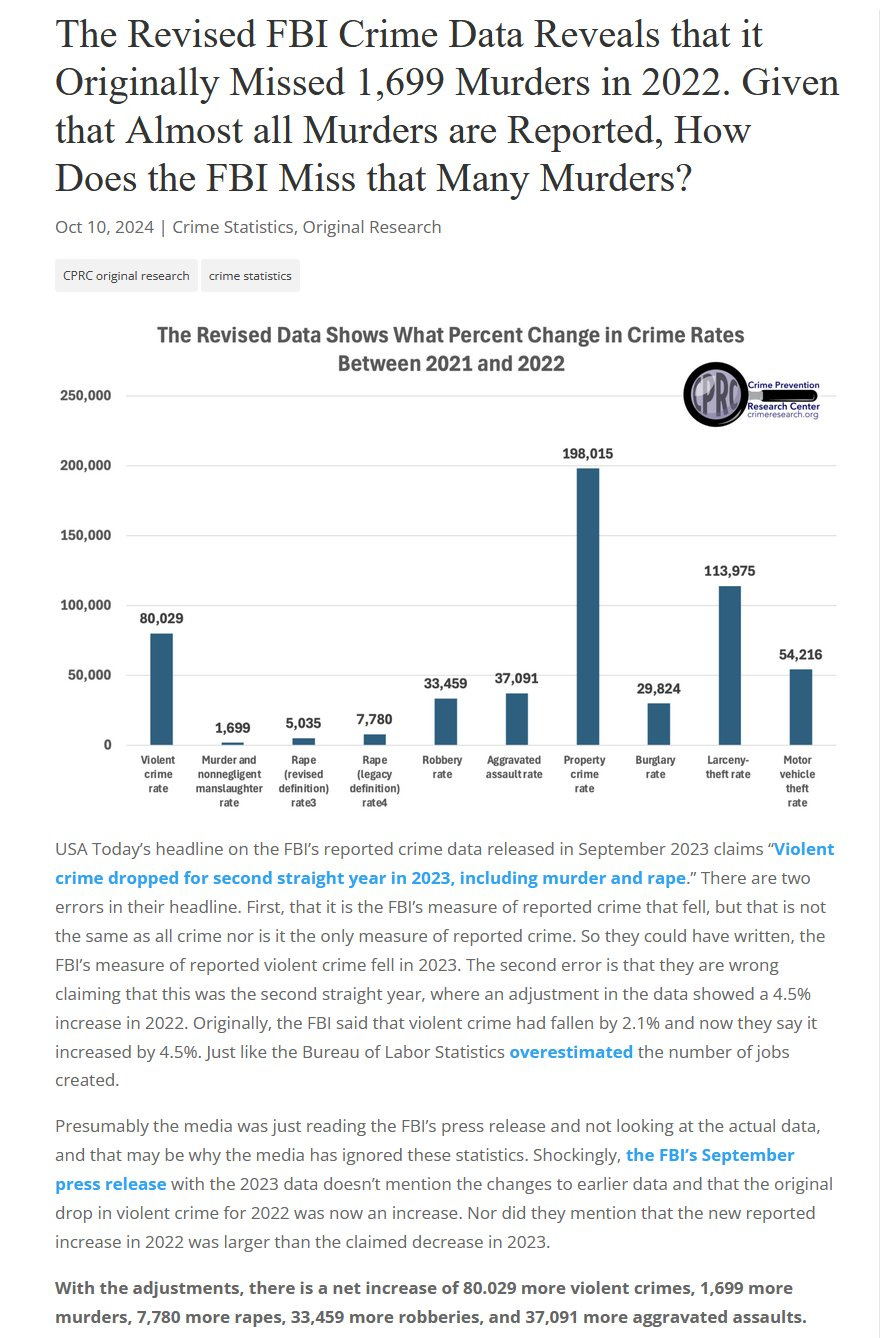
These revisions go beyond minor tweaks. The updated 2022 data shows an increase of 80,029 violent crimes compared to 2021, including an additional 1,699 murders, 7,780 rapes, 33,459 robberies, and 37,091 aggravated assaults. Such a dramatic shift begs the question: Should we trust the FBI’s crime data going forward?
This is not the first time government agencies have been accused of revising critical data without proper disclosure. Earlier this year, the Bureau of Labor Statistics also quietly revised its job creation numbers, reducing the original estimate by 818,000 people. This pattern of silent corrections raises concerns about the accuracy and transparency of government data in general.
The Black Box of FBI Crime Data
The revisions also highlight a deeper issue with how the FBI collects and reports crime data. The FBI doesn’t simply count crimes reported to police—it uses estimates to account for incomplete data. These estimates rely on reports from police departments, many of which only provide partial-year data, and in some cases, cities report no data at all. Over time, the Bureau’s method of generating these estimates has shifted, impacting the crime rates reported to the public.
“The FBI’s processes, such as how it tries to ‘estimate’ unreported figures, has long been a black box, even to the Bureau of Justice Statistics,” said Jeffrey Anderson, former head of the DOJ’s Bureau of Justice Statistics. This lack of clarity makes it difficult for the public, researchers, and even lawmakers to fully understand how much guesswork goes into the “final” numbers the FBI releases each year.
Many experts believe that the FBI should have issued a clear explanation or press release regarding the significant 6.6% change in violent crime for 2022. Instead, the public was left in the dark, relying on independent researchers like Anderson and Moody to uncover the truth.
The Problem With Unreported Crimes
Another challenge with the FBI’s crime data is that it only tracks reported crimes. But according to the National Crime Victimization Survey (NCVS), only 45% of violent crimes and 30% of property crimes are ever reported to law enforcement. This discrepancy means the FBI’s data may paint an incomplete or misleading picture of crime in the U.S.
Nonreporting doesn’t affect all crimes equally. For instance, nearly all murders are reported, but rapes, assaults, and robberies often go unreported. However, the reliability of even the murder rate is questionable after the FBI underreported 1,699 murders and 54,216 motor vehicle thefts in its initial 2022 data.
What Do the Alternative Numbers Show?
The FBI isn’t the only agency tracking crime in the U.S., and its recent revisions stand in stark contrast to data from other sources. The Bureau of Justice Statistics’ NCVS, which interviews 240,000 people annually about their personal experiences with crime, paints a far more alarming picture.
According to the NCVS, violent crime actually increased by 4.1% in 2023. Even with the FBI’s revised numbers, the 4.5% increase in 2022 pales in comparison to the NCVS’s finding of a 29.1% increase that year.
Additionally, the NCVS reports staggering increases in crime during the Biden administration: rape is up 42%, robbery is up 63%, and aggravated assault has surged by 55%. These figures mark the largest three-year increase in violent crime since the NCVS began tracking crime rates decades ago.
What Does This Mean for the Future of Crime Reporting?
With the FBI’s revisions leaving many unanswered questions, it’s clear that public trust in government crime data is at risk. “This lack of transparency harms the FBI’s credibility,” said David Mustard, a crime researcher and professor at the University of Georgia.
While headlines earlier this year declared that violent crime was plummeting, it’s becoming increasingly clear that these rosy narratives may have been based on incomplete or inaccurate data. As Americans continue to express concern about rising crime rates, particularly in urban areas, the discrepancy between reported and unreported crime has never been more critical to address.
As the FBI prepares to release its 2023 data, many will be watching closely to see if the Bureau once again quietly revises its numbers—and whether the public will finally get the full story.
SOURCE:
https://www.realclearinvestigations.com/






 https://substack-post-media.s3.amazonaws.com/public/images/d2ea9316-1358-4bd7-97b5-7a04f92a0b2a_1100x100.png (1100×100)","title":null,"type":null,"href":null,"belowTheFold":false,"topImage":false,"internalRedirect":null,"isProcessing":false,"align":null,"offset":false}" class="sizing-normal" alt="