Dave Bondy
Politics • Culture • News
Proposed Michigan Health Standards Raise Questions on Parental Rights
Supporters call the updates modern, while critics warn they could overstep Michigan’s health education requirements.
October 10, 2025
post photo preview

LANSING, Mich. — Michigan’s effort to overhaul its K–12 health education standards has ignited a political and cultural firestorm, with critics accusing the state of embedding gender and diversity ideology into required coursework that parents cannot opt their children out of.

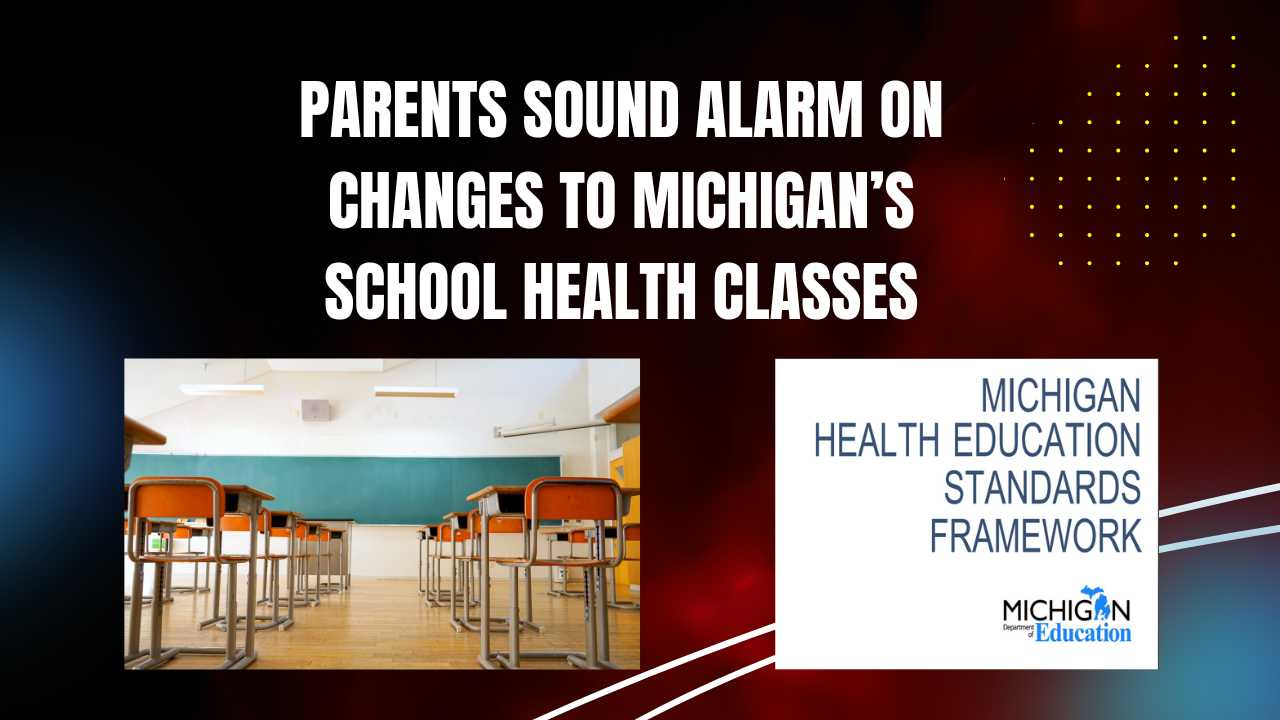
The proposed Health Education Standards Framework, released in September by the Michigan Department of Education (MDE), is the first such update since 2007. Officials say the changes modernize lessons on mental health, substance abuse, relationships, and wellness to match contemporary realities. But parental rights groups, editorial voices, and political candidates warn the revisions cross a line, blurring the boundary between required health instruction and elective sex education, and undermining state laws that guarantee families opt-out rights.

The Michigan Department of Education is taking comments from the public at this link up until midnight on October 10.


What the draft would change

The framework expands instruction across multiple areas:

  • Mental and emotional health: More emphasis on resilience, coping skills, and social-emotional learning.

  • Healthy relationships and sexuality: Lessons on consent, gender identity, sexual orientation, and inclusive language.

  • Substance use: Updates covering vaping, prescription misuse, and harm reduction.

  • Personal health, safety, and wellness: Broader connections between health, community, and environment.

I can’t do this without you. For less than $1 a week, become a paid subscriber if you don’t already and support real journalism. Click red button below to help.

Subscribe now

According to the draft, students as young as middle school would learn to “apply a decision-making process” to “sexual relationships” and discuss “consent or non-consent.” By high school, students would be expected to support programs that “promote respect for people of all sexual orientations, gender identities, and gender expressions.”

Supporters say the update reflects national health standards and aims to be “culturally responsive.” Critics call it a blueprint for embedding sexual and gender identity instruction in mandatory health classes, circumventing the statutory rules that govern sex education.


Critics: “A back-door effort”

Kaitlyn Buss, editorial page editor for the Detroit News, blasted the plan in a recent column. She described it as “an identity agenda, beginning in the earliest grades, marked by wholly inappropriate instruction on gender fluidity, sex and relationships as the students age into middle school.”

If you have not yet signed up to this FREE newsletter please do so now to stay up to date.


Buss argued the framework “folds sexually centered guidelines into regular K–12 health classes” that are separate from elective sex education under Michigan law. “What the Education Department is planning is a back-door effort to enact stalled legislation … that would have rewritten sex ed language and allowed contraception to be given out at schools,” she wrote.

The editorial cited passages directing middle schoolers to role-play discussions about consent and affection. “What does it look like in practice for a teacher to role-play ‘non-consent’ to a classroom of middle schoolers? The possibilities for harm are endless,” Buss wrote.

She warned that the draft encourages students to become LGBTQ activists and “subject them to inappropriate, sexually explicit instruction,” concluding: “These aren’t topics that need to be explored in a school setting, regardless of the available opt-outs. The State Board of Education should reject Rice’s proposed changes outright.”


Faith and advocacy groups echo concerns

Faith-based advocacy organizations share those worries. Katherine Bussard of Salt & Light Global said the state has been “misleading and dishonest” in describing how opt-outs would apply.

“Health class is mandatory K–12. Sex education courses are separate, with different statutes that include opt-out provisions,” Bussard wrote. “Teaching content related to sex education in health class is still health class, governed by health class laws.”

She pointed to Michigan’s compulsory attendance laws, warning that parents who withheld their children from mandatory health classes could face truancy or other penalties.


Political voices: parental rights under threat

Republican attorney general candidate Kevin Kijewski called the proposal “a blatant overreach” that undermines parental authority. “The Michigan State Board of Education wants to strip away parents’ rights to opt their children out of lessons on gender and sexual identity that have no place in our schools without transparency and consent,” he said in a message to supporters.

Kijewski urged residents to submit public comments before the October 10 deadline, vowing to launch a Division of Parental and Student Rights if elected.


The state’s defense: modernization and local control

MDE officials insist nothing in the draft changes parental rights under Michigan law. “In Michigan, parents can opt out of sex education programs,” spokesperson Bob Wheaton said. “General health education is a graduation requirement under Michigan law. Sex education is not mandated, with the exception of instruction about HIV, which since 2004 has been mandated by state law.”

Former Superintendent Michael Rice, who retired October 3, defended the revisions as necessary to reflect “current trends, terminology, and best practices.” He said the standards would make instruction “more culturally responsive” and align Michigan with national benchmarks.

The department emphasizes that local districts will decide how to implement sexual health content, guided by sex education advisory boards made up of at least 50 percent parents.


Legal backdrop

Michigan law separates health education and sex education:

  • MCL 380.1170 and related statutes make health education mandatory for all K–12 students and part of the Michigan Merit Curriculum.

  • MCL 380.1507 governs sex education, requiring parental notice, advisory board review, and opt-out rights.

Critics argue that by embedding topics like gender identity and sexual orientation into health courses, the state effectively bypasses opt-out protections designed for sex education.


District challenges

Even if adopted, the framework leaves practical hurdles:

  • Curriculum adoption: Districts must decide how to meet standards while balancing community concerns.

  • Teacher training: Instructors may need preparation to handle sensitive discussions on identity and consent.

  • Transparency: Schools will have to manage parental requests for review and potential opt-outs.

  • Community alignment: Districts in conservative areas may face pushback, board fights, or lawsuits.


What’s next

Public comment on the draft standards closes at midnight October 10. The State Board of Education will then review feedback before voting on final adoption. Newly appointed Superintendent Glenn Maleyko is expected to play a pivotal role in deciding whether to continue Rice’s approach or modify it.

Lawmakers are already signaling their own response. The House is expected to introduce a resolution opposing the framework, setting the stage for further clashes in Lansing.

Regardless of the outcome, the controversy has already ensured that health education will be a flashpoint in Michigan’s education and political debates, pitting parental rights against calls for more inclusive instru

community logo
Join the Dave Bondy Community
To read more articles like this, sign up and join my community today
0
What else you may like…
Videos
Posts
Articles
Flint man says city won't help him withe next door eyesoar.

He did everything right. Bought a broken-down home in Flint and rebuilt it for his family. Now he’s living next to a burned-out property that’s been sitting for months. He says he’s called for help over and over with no response. This is what happens when people trying to do the right thing are left on their own.

00:13:42
Michigan House Bill 5711, which would roll back the state’s clean energy mandates for utilities, has cleared the House Energy Committee and is headed to the full House for a vote. If approved there, it would move to the Senate for consideration.

Michigan House Bill 5711, which would roll back the state’s clean energy mandates for utilities, has cleared the House Energy Committee and is headed to the full House for a vote.
If approved there, it would move to the Senate for consideration.

00:00:26
🚨The Village of Birch Run, Michigan doesn’t record or live stream their public meetings. They’re not legally required to, but I think it would be something good to do for transparency. I talked to the village president who did not want to touch the issue.

🚨The Village of Birch Run, Michigan doesn’t record or live stream their public meetings. They’re not legally required to, but I think it would be something good to do for transparency. I talked to the village president who did not want to touch the issue.

00:01:16
Help me to continue this work

Do you like my work? If you ard not yet a paid subscriber please consider becoming one. I have way more stories than I can handle and I want to hire people to report for me. Consider becoming a paid subscriber for less than $1 per week. Click the button below.

That didn’t take long. Gas has hit basically five dollars a gallon here off of Saginaw Road in Bay City, Michigan. MichiganGasPrices GasPrices

That didn’t take long. Gas has hit basically five dollars a gallon here off of Saginaw Road in Bay City, Michigan. #MichiganGasPrices #GasPrices

post photo preview
The USGS says a magnitude 2.9 earthquake hit about 7 km south southeast of Amherstburg, Canada, just across from the Detroit area. It happened at a shallow depth of about 2 km. Did you feel anything in Mid Michigan or Metro Detroit?

The USGS says a magnitude 2.9 earthquake hit about 7 km south southeast of Amherstburg, Canada, just across from the Detroit area. It happened at a shallow depth of about 2 km.

Did you feel anything in Mid Michigan or Metro Detroit?

post photo preview
News they don't want you to see
Thursday April 30, 2026

I’m going to be honest with you. Right now, it’s just me juggling more stories than I can realistically handle, and I don’t want to start cutting corners or slowing down.

I’m trying to bring on help so I can keep delivering at a high level and grow this into something even bigger. But I can’t do that without your support.

If you believe in what I’m building, consider becoming a paid subscriber for $1 a week. Click below and help me take this to the next level.


Close the backdoor drug pipeline that’s emboldening enemies and harming the public

It’s not often that Congress gets a do-over or can correct the unintended consequences of the laws they pass. As a former acting secretary of Homeland Security, I saw first-hand how legal loopholes are exploited — by both U.S. entities and our adversaries — and their impact on the American people. That impact can largely be classified as either a public safety or ational security threat, and in many instances — both.

Today, we are seeing such impacts playing out with the highly potent drugs made with hemp-derived tetrahydrocannabinol (THC) flooding the market with largely unregulated distribution to America’s youth. Click here to read more.


Covid-19 vaccine injury program paid for one death in March, denials exceed 98%

The federal government’s Covid-19 vaccine injury compensation program paid benefits for seven injuries in March, including one death.

As of April 1, the program has compensated 51 of 6,944 claims decided, while denying 6,847 — a denial rate exceeding 98%.

The March payment marked only the second death benefit issued since the start of the pandemic.

The Countermeasure Injury Compensation Program (CICP), created under the PREP Act, is the primary path for claims related to Covid-19 vaccines. The law shields manufacturers from liability during public health emergencies. Click here to read more.

https%3A%2F%2Fsubstack-post-media.s3.amazonaws.com%2Fpublic%2Fimages%2Fd2ea9316-1358-4bd7-97b5-7a04f92a0b2a_1100x100.png


Playing Cops: Criminals Pretending To Be Police Is a National Problem

Working at a 24/7 bodega in the heart of Brooklyn, Tajuken Deli employees are prepared for almost anything – except having guns pointed at their heads by cops.

That’s what seemed to be happening one early April morning last year, when four armed men dressed in police uniforms flashed their badges, yelling “NYPD” as they stormed the neighborhood shop. Surveillance video shows one worker being quickly knocked to the ground and zip-tied into submission before being dragged to the back of the store. Another worker and customer were also subdued as the masked thieves dressed as cops made off with cash and a bag of lottery ticket receipts before fleeing in a dark van.

“You don’t know who to trust nowadays,” local resident Danny Taylor told a TV reporter. Click here to read more.


UFO whistleblowers issue chilling warning after Air Force officer was found dead before he could testify

UFO whistleblowers are facing alleged attempts to silence them as they move to expose what they believe are some of America’s most closely guarded secrets.

Investigative journalist Jeremy Corbell, who has helped bring multiple whistleblowers before Congress, warned that the risks facing these individuals extend far beyond public scrutiny.

‘They’re giving up their security clearance, they’re giving up their security, they’re putting their family at risk, they’re putting themselves at risk, if by stigma alone,’ Corbell, who details several cases in his upcoming film Sleeping Dog, told the Daily Mail. Click here to read more.


Big Brother Is Riding Shotgun: Driver

WASHINGTON, D.C. – A new surveillance era is set to get behind the wheel next year.

The Infrastructure Investment and Jobs Act, passed by Congress in 2021 and billed as a way to help the country recover from the COVID-19 shutdowns, included a statute requiring new cars to have driver-monitoring systems. The goal is to detect impaired drivers through cameras and sensors that analyze eye movement, head position, and alertness.

U.S. Senators Gary Peters and Debbie Stabenow (now retired) voted for the bill. In addition, then-House Representatives Dan Kildee, Elissa Slotkin, Andy Levin, Haley Stevens, Debbie Dingell, and Brenda Lawrence, all Democrats, voted yes. GOP Representative Fred Upton, now retired, also voted yes. Click here to read more.


Read full Article
News they don't want you to see
Wednesday April 29, 2026
Read full Article
News they don't want you to see
Tuesday April 28, 2026
Read full Article
See More
Available on mobile and TV devices
google store google store app store app store
google store google store app tv store app tv store amazon store amazon store roku store roku store
Powered by Locals